
Why Do UK Contractors Outsource BIM Modelling?
July 17, 2026
Written by BIM Outsourcing
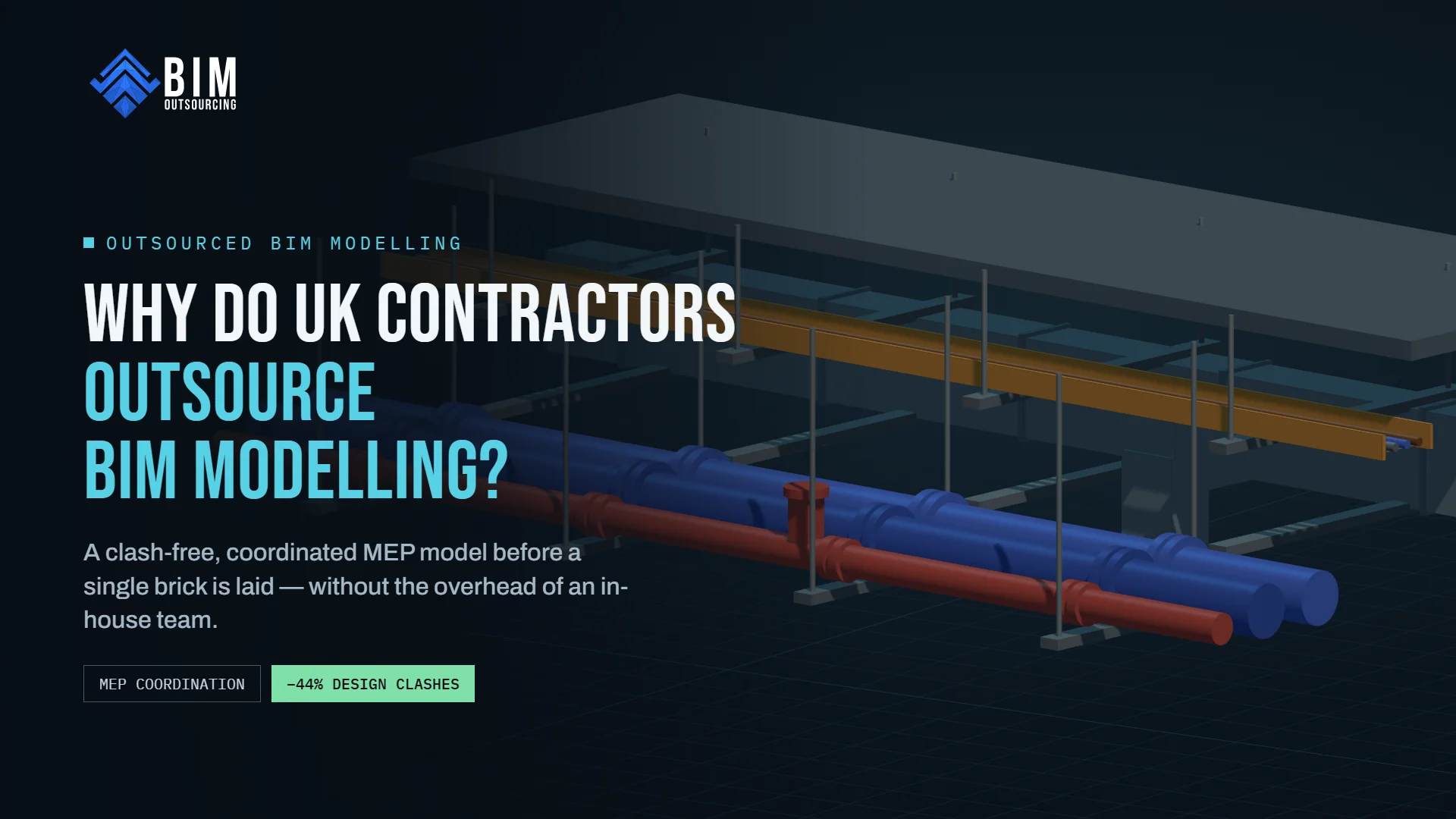
The core reason to outsource BIM modelling is to prevent the overhead expense of an in-house modelling team while ensuring the delivery of a clash-free and well-coordinated model, before laying a single brick on site. UK contractors hire outsourced BIM departments. They identify and resolve potential MEP clashes, prepare builders' work drawings, and riser layouts, and hand over a construction-ready model to ensure a seamless installation process with fewer delays and RFIs.
The Cost of a Poorly Coordinated Model
A lot of clashes are preventable, yet they just need proper decisions. If not addressed properly, they emerge on site. Conflicts such as inadequate space in the ceiling void zone for services installation are already present in the design; however, they are not visible.
The emergence of such issues during the execution phase rather than the design phase might end up with the contractor encountering a delayed and uneconomical project with a bunch of RFIs. Conversely, if we speak of a coordinated model, the story could be otherwise. Clashes and risks would have been highlighted and resolved during the design phase before real-world execution. Ultimately, that is why contractors outsource BIM modelling.
Further information on BIM workflow can be found in the UK BIM Framework.
Case Study: Maidstone Innovation Centre
TThe Maidstone Innovation Centre, a four-storey office development on the Kent Medical Campus, is a testament to how, during the pre-construction phase, BIM coordination can really bring value to the project.
Pope Consulting, the MEP consultant, commissioned BIM Outsourcing to undertake MEP modelling for this project. We worked alongside the design team and the contractor, reduced 44% design clashes, and delivered a well-coordinated model ready for on-site execution, which included builders' work drawings, plant room models, riser layouts and Revit families.
Although our appointment was made by the consultant, it is evident that the contractor was the primary beneficiary. This was due to fewer clashes and RFIs.
How Outsourcing BIM Modelling Benefited the Contractor
To demonstrate the benefits that a contractor receives by outsourcing BIM modelling, one of the key examples was the ceiling void in the Maidstone Innovation Centre project. Having interdisciplinary services such as Mechanical, Electrical, and Plumbing occupying the same space was near impossible. This congestion issue, if left unresolved during the design phase, could pave the way to on-site delays and costly rework. Therefore, we took this matter as an early priority and, after working closely with the consultant and the contractor, made significant changes. In the initial stages, there were some spaces where clashes were unavoidable, so we strategically rerouted multiple services using BIM coordination and clash detection while accommodating the desired access and clearances.
With this proactive approach, we ensured fewer delays, RFIs, rework, and coordination issues among disciplines on-site, ultimately contributing to the contractor's benefit by saving him valuable time and money through seamless project delivery, early problem detection, and resolution. This is exactly the practical reason that makes contractors outsource BIM modelling.
Why Contractors Outsource Rather Than Build In-House
My take is that outsourcing BIM modelling benefits UK contractors in ways that in-house modelling cannot. It eliminates the need to recruit, train, and maintain an in-house department while fulfilling the contractor's checklist. What typically is included in a contractor's checklist is as follows:
- Faster model production
- Project scalability according to project demand
- Improved coordination
- Fewer RFIs on-site
- Less rework
- Confidence in the final output, i.e., the execution of the built model in the real world
If the entire outsourcing workflow is implemented properly, BIM modelling can save a lot more time and money than it actually demands to produce a precise model. This is the reason that makes it a worthwhile decision for contractors to make.
Client Feedback
"We appointed BIM Outsourcing to undertake the modelling for a four-storey office development in Maidstone and have been really pleased we did. Arfin has been helpful, proactive, and responsive throughout. And together we have a great model ready for construction. We are now working together on a nursing home and look forward to many more collaborations."
~ Neil Champion
Director Pope Consulting
Such client feedback reflects the real value of outsourcing BIM modelling. When a contractor, consultant, or client shows their trust and confidence in you, it is only possible through successful project delivery and efficient collaboration.
FAQs
Does outsourcing BIM modelling mean losing control of the design?
Absolutely not. The contractor and any other stakeholders involved in the project are kept informed throughout the process about any concerns. What the outsourcing team does on their part is follow the design, identify potential clashes, and report them to the stakeholders. The rest of the formalities, including decision-making, lie in the hands of the contractor. This is usually done through RFIs during the pre-construction phase.
What kind of potential clashes can we detect using BIM coordination during the pre-construction phase?
Clashes could be of any nature, i.e., hard, soft, or 4D (sequencing) clashes. However, in our case study, it was a soft clash, which we usually refer to as a spatial issue. We faced restrictions in adjusting the services within the provided ceiling void. With the utilisation of BIM coordination, these issues were later overcome, and the installation was carried out smoothly on-site without any inconvenience.
How much does outsourcing BIM modelling save?
The whole point of outsourcing BIM modelling is that you get to know the risks of the project in the earlier phases. Instead of identifying them during construction, you always get an edge by getting your hands on them in a digital environment, mitigating all the risks that could affect project productivity. That is exactly where you save money. In short, it costs you a lot on-site when materials are already in use during construction, whereas a fraction of that cost is incurred during the modelling phase.