
Bim Process
ISO 19650 vs PAS 1192: What Does Your Project Actually Need?
August 18, 2026
Written by BIM Outsourcing
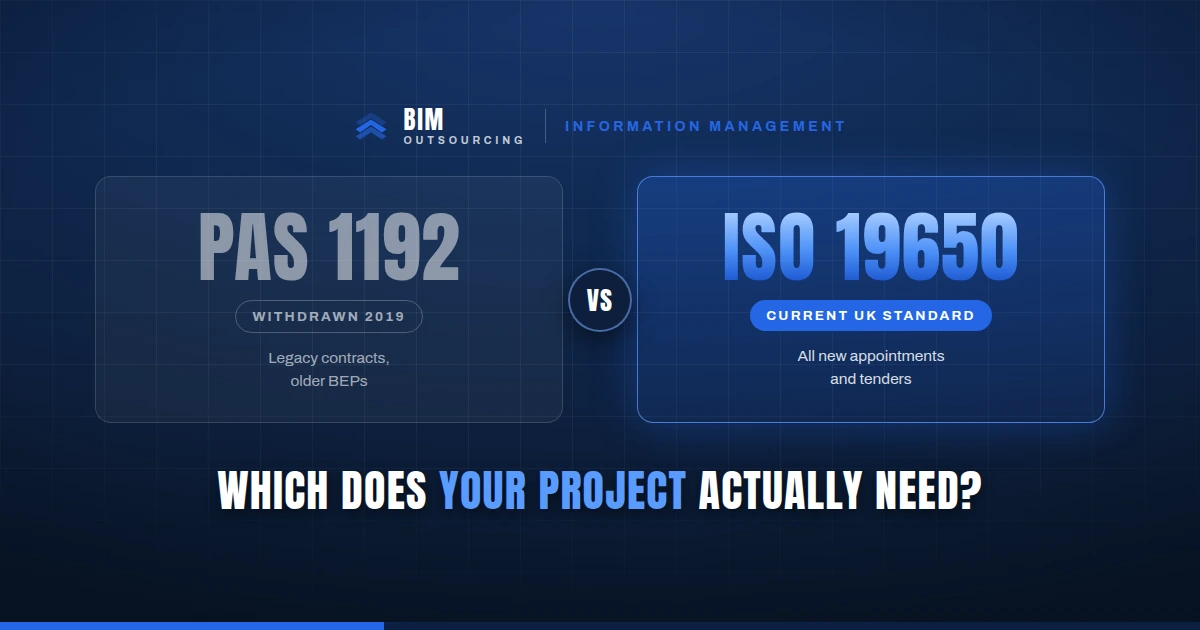
Since 2019, BS EN ISO 19650 has served as the current standard across the UK industry, replacing PAS 1192, which was previously used for information management in public sector projects. They both have distinct documentation and terminology, yet they follow the same BIM workflow. PAS 1192 is still in use for legacy projects.
ISO 19650 vs PAS 1192: A Side-by-Side Comparison
| Criteria | PAS 1192 (series) | ISO 19650 (series) |
|---|---|---|
| Status | Withdrawn by BSI (British Standards Institution) in 2019 | Currently in use in the UK |
| Origin | UK-specific standard built on BS 1192 | International standard adopted in the UK as BS EN ISO 19650 |
| Adoption | UK BIM Level 2 projects | New projects in the UK or globally |
| Core Structure | EIR, CDE, PIM/AIM, revision and status codes | Same principles with updated terminology and documentation |
| Usage | Legacy contracts, older BEPs, and projects initiated before 2020 | All new project appointments and tenders |
What’s Different in ISO 19650?
Many of you believe the myth that ISO 19650 brought significant changes to the way we model, which is not true. The entire workflow is the same; rather, it provides an improved approach to managing project information. It sets clearer rules for naming, organising, reviewing, approving, and sharing information.
What actually changed is the terminology. Employer’s Information Requirements turned into Exchange Information Requirements, and for organisations, projects, and assets, the standard has included separate requirements. Moreover, some widely understood concepts, such as the Common Data Environment (CDE), WIP, Shared, Published, and Archive states, and revision and status codes, are retained. Teams adopting PAS 1192 can work with the existing workflow while making documentation changes.
Why ISO 19650 is the Right Choice Today
Drawing on our insights, we recommend using BS EN ISO 19650 for UK projects. The reason is simple: it is based on the same principles as PAS 1192 and BS 1192, and is widely recognised across the UK for managing project information.
Consistent and organised information is attainable utilising ISO 19650. File names, revision codes, asset information, and approvals all follow the same method, making it more straightforward for everyone involved to find, share, and have confidence in project information throughout the asset’s lifecycle.
What makes it particularly important is the fact that it is being used globally and known to many people, whether they’re contractors or consultants. If you still go with the superseded PAS 1192 standard for a new project, you might end up facing unnecessary confusion and last-minute documentation changes.
Where PAS 1192 Remains in Use
Although things have changed, ISO 19650 has replaced PAS 1192, but there are some projects where PAS 1192 is still in use. These projects started before the transition from PAS 1192 to ISO 19650 and we refer to them as legacy projects. What’s important is to ensure alignment of project naming conventions, abbreviations, and container references with the contractually defined standard. Failing to do so may lead to the use of incorrect terminology, creating compliance issues later.
How We Applied ISO 19650 on Real Projects
A recent project of ours putting ISO 19650 into practice included BMS systems, where we, in line with the standard, managed information throughout design and construction. The inclusion of revision and status codes on all information containers was ensured as a priority, and the EIR and BEP established the naming convention rules for files and asset information. Doing so assisted everyone in working with easily accessible and up-to-date information.
In compliance with the agreed BIM requirements, we also created and delivered Revit families. The implementation of naming conventions, revision codes, and status codes was done for these as well. For the addition of COBie information such as Type, Component, and Location, we incorporated BIM interoperability. The deliverables were shared in both Revit and IFC formats for seamless accessibility across other platforms.
We did a project of the same nature involving the modelling of security systems. As was done in the earlier one, similar principles were applied in adherence to the ISO 19650 standard, including naming conventions, revision control, status codes, and IFC exports. COBie was excluded as it was not asked for in the contract. This demonstrates that ISO 19650 shows how to manage information, while what needs to be included is entirely dependent on what the EIR specifies.
Post-construction, 3D scanners were put into use to ensure the installed equipment matches the Asset Information Model (AIM). Through this approach, we had confidence during facility handover as the information was accurate and would prove essential for future asset management.
Key Lesson: Set the Rules Before the Modelling Begins
The main lesson from these projects is to agree on the information management standards and naming conventions before BIM modelling starts. If these are decided later, the team may have to go back and fix inconsistent names, status codes, and other information. Setting the requirements clearly in the BEP and EIR from the beginning can save time, reduce errors, and avoid unnecessary rework.
FAQs
Is PAS 1192 still relevant today?
No. BSI began superseding PAS 1192 with the ISO 19650 series in 2019. You may encounter it in older BEPs, ongoing projects, and legacy projects. However, for new UK projects, implementing ISO 19650 is recommended as it is the current framework for information management.
Do private projects need ISO 19650?
No. Not by law. However, adopting its principles will help private projects manage information and work effectively with project teams.
Can we switch to ISO 19650 mid-project?
Yes. As we know, PAS 1192 and ISO 19650 adopt the same BIM approach. What actually sets them apart is their terminology, documentation, requirements, and processes. To ensure compliance with ISO 19650, you need to make changes to those aspects, and you may retain the existing model with the necessary reviews and alignments.
If you want models, drawings, and information containers set up to ISO 19650 from the outset, get in touch for a no-obligation quote.