
2D vs 3D Drawings in Construction: When Do You Need Each?
September 15, 2025
Written by BIM Outsourcing
Introduction
In the context of construction, drawings are the primary medium for communicating ideas and concepts, whether you come from a technical or non-technical background. They assist stakeholders such as designers, engineers, contractors, and clients in understanding what needs to be built on-site and how it will look upon completion. In the modern era, there are two main types of drawings: 2D drawings and 3D models. When considering their benefits, each has its own advantages in different cases and situations. However, it is important to understand these situations to better choose the required option, save time and money, and avoid potential mistakes, keeping the project on a smooth track throughout execution.
What are 2D Construction Drawings?
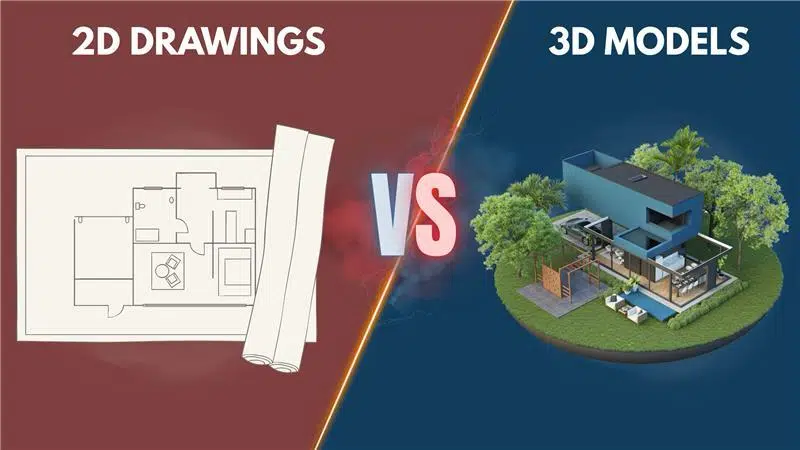
Conventional drawings that are made in a two-dimensional plane, i.e., the X and Y plane, are known as 2D construction drawings. They include sections, floor plans, detailed views, and elevations of building components and services. CAD (Computer-Aided Design) software is used for the creation of these drawings, and they are shared in universal formats such as DWG and PDF.
They play a vital role in construction as they are easy to understand, precise, and globally recognised across the AEC (Architecture, Engineering, and Construction) industry. On-site contractors and workers still choose to execute the entire project with the assistance of these clear drawings. Since they provide exact technical information in a standard format, regulatory bodies also prefer 2D submissions for permissions and approvals.
What are 3D Construction Models?
3D models are digitally powered versions of a structure without on-site execution. They are modelled using BIM (Building Information Modelling) software such as Revit or ArchiCAD. These models go beyond geometry, meaning they are data-rich models that provide information about materials, systems, and how they fit and function together. Unlike 2D CAD drawings, a 3D model enables stakeholders to walk through and experience how elements spatially interact with each other in real time. They are shared in RVT and IFC formats.
As 3D models are created digitally, the client gets the final output before execution, helping in better visualisation, and for engineers, they serve as a tool for interdisciplinary coordination during the design phase. They can detect and resolve clashes ahead of time, saving costs and time, reducing rework, and enhancing the overall efficiency of the project.
When to use 2D or 3D in Construction?
Both 2D and 3D are considered essential, but their utilisation depends on the project stage and requirements.
- For approvals and bidding
When it comes to approvals and bidding, 2D drawings are the besBt choice, as government authorities often ask for 2D submissions. They are also used by contractors in the preparation of cost estimates and quantity takeoffs.
- On-site
2D drawings play a pivotal role during on-site execution of a project because they offer flexibility in carrying, reading, and marking on paper and tablets without the need for any special software, which makes site teams and supervisors dependent on them.
- For design and coordination
To ensure design coordination among different disciplines such as architecture, structural, and MEP (Mechanical, Electrical, and Plumbing), 3D models work best. They allow the teams to spot clashes, from minor to major, by providing an out-of-the-box view before construction begins.
- For clients and presentations
3D models are very effective in helping non-technical people understand the complete construction sequence, as well as for visualisation purposes.
What does ‘BIM to 2D Drawings’ Refer To?
In modern construction, BIM to 2D Drawings means creating a 3D BIM model first, and then using it to generate precise 2D drawings. By doing so, this approach combines both the BIM model and 2D drawings, making them ready for tenders, approvals, and on-site work.
Conversion of BIM to 2D provides the team with:
- Accurate and consistent data.
- Reader-friendly drawings for on-site workers.
- Drawings compliant with industry standards and authority requirements.
This approach ensures that stakeholders not only get an accurate 3D BIM model, but also reliable and clear 2D drawings extracted from that model, leading to fewer mistakes on site.
Conclusion
By comparing the pros and cons of 2D and 3D construction drawings, we can conclude that both have their importance and advantages in the construction industry, depending on the project stage and requirements. 2D drawings are used for tenders, approvals, and on-site purposes. On the other hand, 3D models, unlike 2D drawings, are helpful in effective coordination and visualisation, reducing errors, and streamlining construction workflows. Using both at once could make the process smoother, more reliable, and easier to execute.
Our UK-based team delivers accurate and clash-free, site-ready 2D drawings. Have a look at the projects we have successfully delivered.