
The power of IFC: Revolutionizing Construction and BIM Integration
December 5, 2024
Written by BIM Outsourcing
What is IFC?
Just like we have PDF format for file sharing, Industry Foundation Classes (IFC) is standardized format used in building information modeling (BIM). It allows different programs to share, access and read the building information easily. In simple words, IFC provides a common language that enables all project stakeholders including owners, architects, engineers, contractors and facility managers. To read and view building data in the same consistent and structured format in which it was developed.
IFC format for sharing BIM data is still evolving, up till now couple of file formats are released as per their specification. IFC 4.3 being the most lastest fully developed officially released version. Apart from .ifc file extension, IFC data can also be exported and saved in other file extension like .ifcXML , .ifczip and .ifcJSON, each having its own advantage and use case .ifc is most commonly used data exchange format, .ifcXML is XML based version used in web applications and systems that rely on XML data, .ifcZIP is a compressed version of IFC data while .ifcJSON is utilized for web integration.
Effective collaboration, seamless data exchange and streamlined workflows are critical aspects in ensuring timely and cost-efficient completion of Constuction projects. As the AEC projects grow more complex, the need for standardized systems to manage the vast amount of data generated becomes increasingly important. This is the point where industry foundation classes (IFC) come into play.
IFC files come from STEP format, mostly implied in manufacturing industry. Similarly, the BIM industry needed a common ground where information could flow continuously from one project stakeholder to another. It is an open, standardized BIM data developed to facilitate interoperability and data exchange across various software's used in the architecture, engineering, construction and operations (AECO) industry. IFC is revolutionizing the BIM industry in terms of project management, design, construction and maintenance.
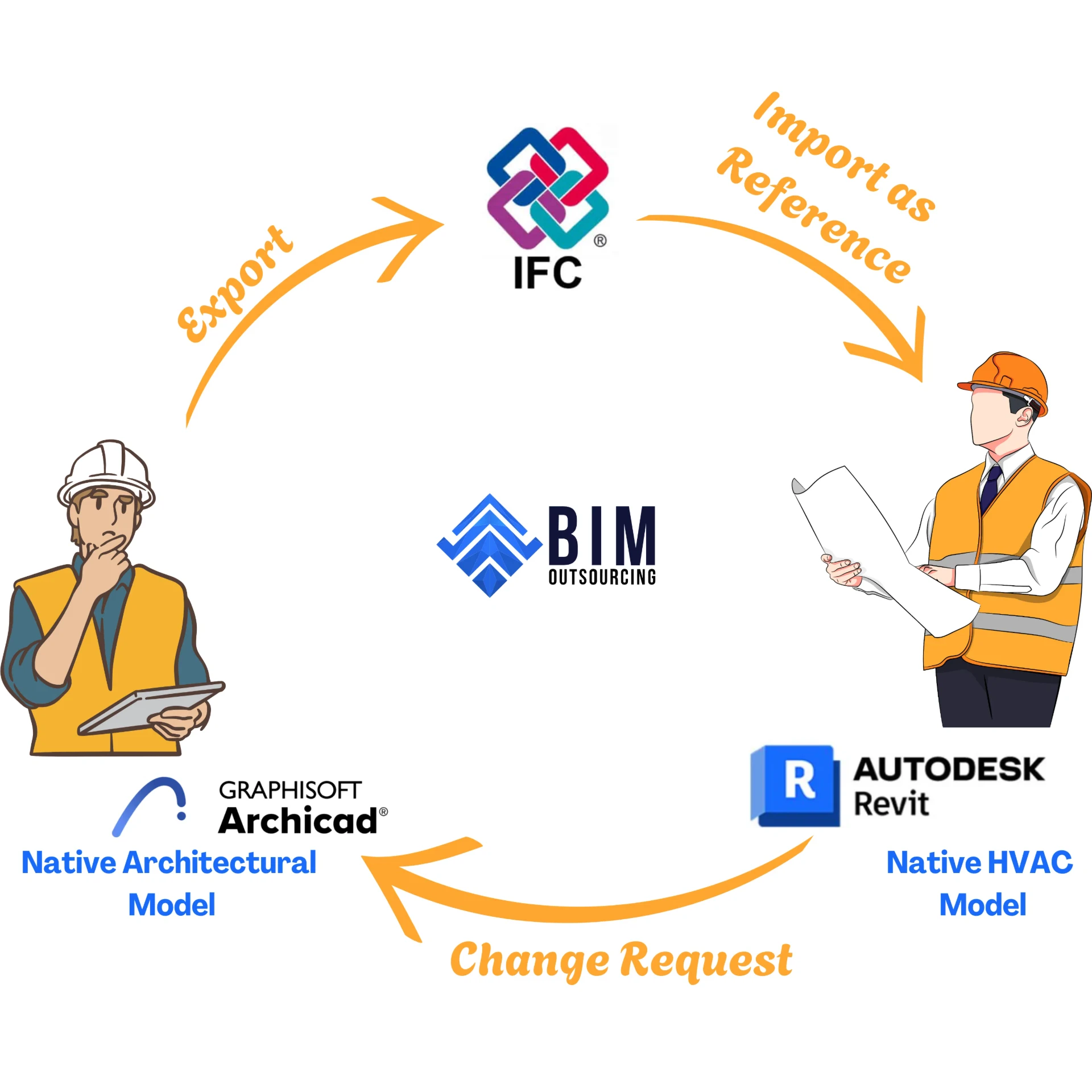
IFC was introduced by buildingSMART, which is a global organization purely focused on improving the digital data exchange of the built environment. IFC has the potential to serve as a bridge between different tools and ensuring the protection of data during the exchange process. A simple example can be the data modeled in Revit, exported in IFC format and accessed through Bently view.
IFC is an open, neutral data exchange format that stores a variety of building information such as geometry, material properties, spatial relationships and metadata of building elements. This set of data is utilized at every stage of project’s lifecycle, as early as project design stage all the way up to operation and maintenance phase.
To make a BIM process to be effective, there is need to have a system emplaced that ensures data can be exchanged between different platforms and interoperable. It allows teams to collaborate without worrying about compatibility issues of file format. Without IFC, teams would be forced to rely on proprietary file formats that may not be compatible with software's from other vendors. It would probably lead to potential errors, inefficiencies and delays in construction projects. IFC can ensure that all teams and their members are working on the same up to date information.
Key features and benefits of IFC
1. Interoperability Across Platforms
The primary advantage of IFC is the ability to facilitate interoperability across different software tools. In the AECO industry, professionals typically use various software to perform their tasks related to designing, planning and quantification etc. For instance, MEP engineers may use Revit, Revizto or Navisworks while structural engineer may rely on Tekla and STAAD.Pro. Each software tool has its own file format, pros and cons depending on the use case and features. Each of these software has its own native file format that makes it difficult for other teams to seamlessly exchange the data.
IFC solves this problem as it provides the universal data standard which is readable by all major BIM software applications. It ensures effective collaboration even if they are using a variety of software's. IFC also ensures that there is no loss of data during the exchange process as it contains critical information about building components, their spatial relationships and specification.
2. Enhanced Collaboration and Communication
Effective communication and collaboration are essential for the success of any construction project. IFC files can be shared easily across different disciplines, so it minimizes the risk of misinterpretation or discrepancies that may arise when more than one format is used. This leads to more efficient project workflows, as it enables the team to quickly access the latest design revisions in real time, request changes and resolve issues. It makes it easier to manage the large and complex projects.
3. Data consistency throughout the Project Lifecycle
Construction projects typically span over several years, right from the initial design stage through construction and then into long term operation. IFC ensures data consistency by maintaining a standardized format that is accessible throughout the entire project lifecycle. This consistency helps reduce errors, avoid rework and streamline decision-making.
4. Long Term Asset Management
IFC benefits beyond the construction phase of the project. Even when the built asset is hand overed, its data continue to be in use and play a vital role in operations and maintenance. Facility management professionals use the same information stored in IFC files to monitor building systems and track maintenance schedules while ensuring energy efficiencies. For Instance, IFC model containing MEP systems and components can be used to monitor building systems, track maintenance and ensure efficiency.
If renovations or upgradations are required, then the IFC model can serve as a valuable reference for planning and coordination.
5. Standardized Data for Sustainability
Sustainability has become a key focus in the construction industry in recent years. Apart from geometric and non-geometric data, IFC also stores data related to energy performance, materials and sustainability metrics. BIM data with in IFC format can be used to simulate energy usage, assess building performance and optimize the design for sustainability. It helps AEC professionals to make more informed decisions about energy efficient materials and systems. In turn it will reduce the environmental impact of the building.
The Future of IFC and BIM Interoperability
Contruction Industry has started adopting digital technologies, the role of IFC is terms of data sharing and interoperability is only set to grow. The newer version, IFC 5 is under development and purely focuses on enhancing interoperability with emerging technologies like IoT and augmented reality. It is evident that IFC will continue to evolve to meet the needs of a digital-first construction industry.
Additionally, the exponential increase in integration of AI, machine learning and automation into construction workflow will surely demand for open standard like IFC. It is to ensure that data can be exchanged seamlessly across systems, software's and stakeholder. All of this without discrepancies and minimal human intervention.