
Machine Learning Applications in BIM: Current Trends and Future Potential
January 10, 2025
Written by BIM Outsourcing
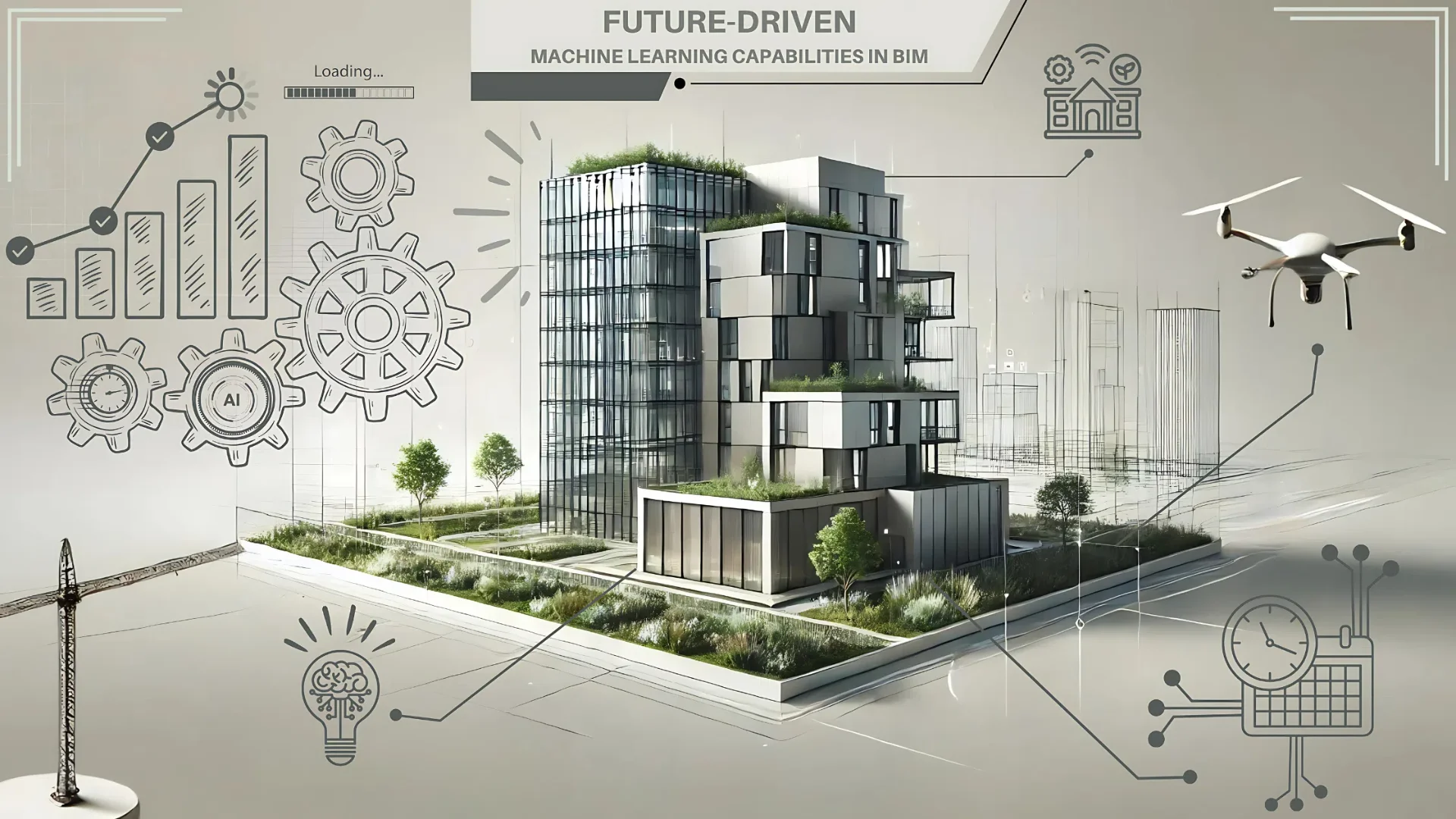
Building information modeling (BIM) has revitalized the AECO industry by creating detailed digital replicas of physical and function aspects of facilities. BIM facilitates collaboration, cost reduction, and increased project efficiency. As technology advances, the integration of machine learning (ML) with BIM is unlocking even greater potential, pushing the boundaries of what can be achieved in construction, design, planning and facility management.
Rise of Machine Learning in BIM
Machine Learning, a subset of Artificial intelligence, that’s where the real magic happens. ML is a process where machines learn to make decisions and predictions on the basis of historic data. ML learning algorithms are developed in such a way that they learn from data, identify patterns, and make decisions with minimal human intervention. BIM provides fertile ground for ML to thrive, as it serves as data repository from 3D models, specifications, sensors data and real-time construction progress.
Current Trends in Machine Learning Applications in BIM
- Automation of Repetitive Tasks
Just like any other industry, machine learning can automate repetitive time-consuming tasks. Generative AI tools, powered by ML enable architects to visualize the BIM model and add aesthetic to it. Veras is a web bases AI powered tool that visualizes 3D models developed in sketup, Revit or any other authoring tool. This AI powered tool can override geometry to explore multiple ideas by modifying the geometry in modeling tool. Rending is another added benefit of Veras which utilizes machine learning to refine the vision with a new text prompt which previously took hours.
Morphis is another tool that utilizes natural language processing (NLP) and unsupervised machine learning techniques to generate design in real-time on Autodesk Revit. Morphis is efficient in predictive analytics, anomaly detection and automating decisions.
Machine learning is also capable of optimizing building design-based several factors including structural integrity, cost, energy consumption and aesthetic preferences. ML can also analyze energy consumption patterns in building models and recommend improvements in layout or materials to optimize energy efficiency.
- Construction Scheduling and Project Management
Construction projects involve countless variables that can affect timelines and costs. When machine learning models are integrated with BIM, it improves the scheduling by predicting delays, optimizes resource allocation and reduces the risk of cost overruns. ML analyzes the historical data and current construction information from sensors to forecast potential disruptions like weather delays, labor shortages, or supply chain issues. It helps project managers at the end to make informed decisions from insight, ahead of time.
Clickup is another AI powered project management tool which automates the workflow where users can set triggers when a task is completed, assigning a new task automatically. Along with that, it can prioritize tasks based on deadlines, dependencies and user input. Additionally, Clickup provides limited AI capabilities to get insights from the dashboards.
- Facility Management and Asset Maintenance
Once the building is constructed and hand overed, BIM data continues to stay in service for facility management and asset maintenance. ML can greatly enhance the capabilities of management in terms of providing insights and predicting the time for upcoming equipment maintenance or replacement.
Infraspeak is a facility management platform that leverages AI, mainly for predictive maintenance and automation to improve operations and eliminate downtime. It is not a fully AI tool in traditional sense and uses a fraction of AI capabilities to enhance its core functionality for facilities and asset management.
Future Potential of Machine Learning in BIM
- AI Driven Decision Making
As technology grows, BIM models continue to grow in complexity, the need to integrate AI and ML algorithm will rise as well. BIM together with IoT sensor data will produce vast amount data which can only be analyzed using machine learning. AI powered systems could assess large data sets and recommend the best course of action in real time, from procurement decisions to risk management strategies. As BIM becomes more interconnected with IoT, sensors, and real-time data streams, the potential for AI to influence design, construction, and operational decisions will increase exponentially.
- Human Centric Design
In the future, construction design will include spaces that are responsive to human needs. By analyzing vast datasets related to human behavior and pattern related to building operations, ML algorithms can help design buildings that adapt to the needs of residents. For instance, using response from air-conditioning sensors and smart systems, ML can adjust lighting, temperature and even lightning colors to match the previous pattern of the occupants. Future machine learning systems integrated with facility management systems will perform this in real-time, enhancing comfort and productivity at the same time.
- Autonomous Construction and Robotics
The future of construction may involve self-reliant autonomous machines, robots and drones, all of them powered by ML and BIM. These robots will be able to perform various tasks such as bricklaying, welding, or even quality inspection on their own. Such robots are programmed with detailed BIM data and real-time analysis from ML models.
Machine learning has vast potential in autonomous construction and robotics, it has an ability to revolutionize the industry by enabling highly intelligent, self-optimizing systems. Robots will not only perform physical tasks, but they will also collaborate seamlessly as well as anticipating problems. Such will have an ability to make real-time decisions to ensure safety, optimize efficiency and resource usage.
Such robots can also assist in project planning if predictive analytics is integrated. Additionally, combining ML learning with other emerging technologies like IoT, augmented reality, and computer vision will further enhance the capabilities of robots. In short, integration of robotics and ML will drastically reduce manual labor and improve productivity in the construction sector.
- Enhanced Sustainability with Predictive analytics
Sustainability is a growing concern for professionals in the construction industry, and ML possesses the potential to help achieve more sustainable solutions. ML algorithms can predict the environmental impact of different design alternatives, material types and construction options. For example, ML can be used to determine the optimal ratios of materials that ensures cost-effective and durability as per the environmental impact.
Additionally, ML lets the architects and engineers optimize building performance in operational phase by continuously analyzing data related to power consumption, lighting and HVAC system. It will help develop strategies that improve building sustainability and energy efficiency to meet green building certification like LEED.