
Automating Routine BIM Tasks with AI
February 7, 2025
Written by BIM Outsourcing
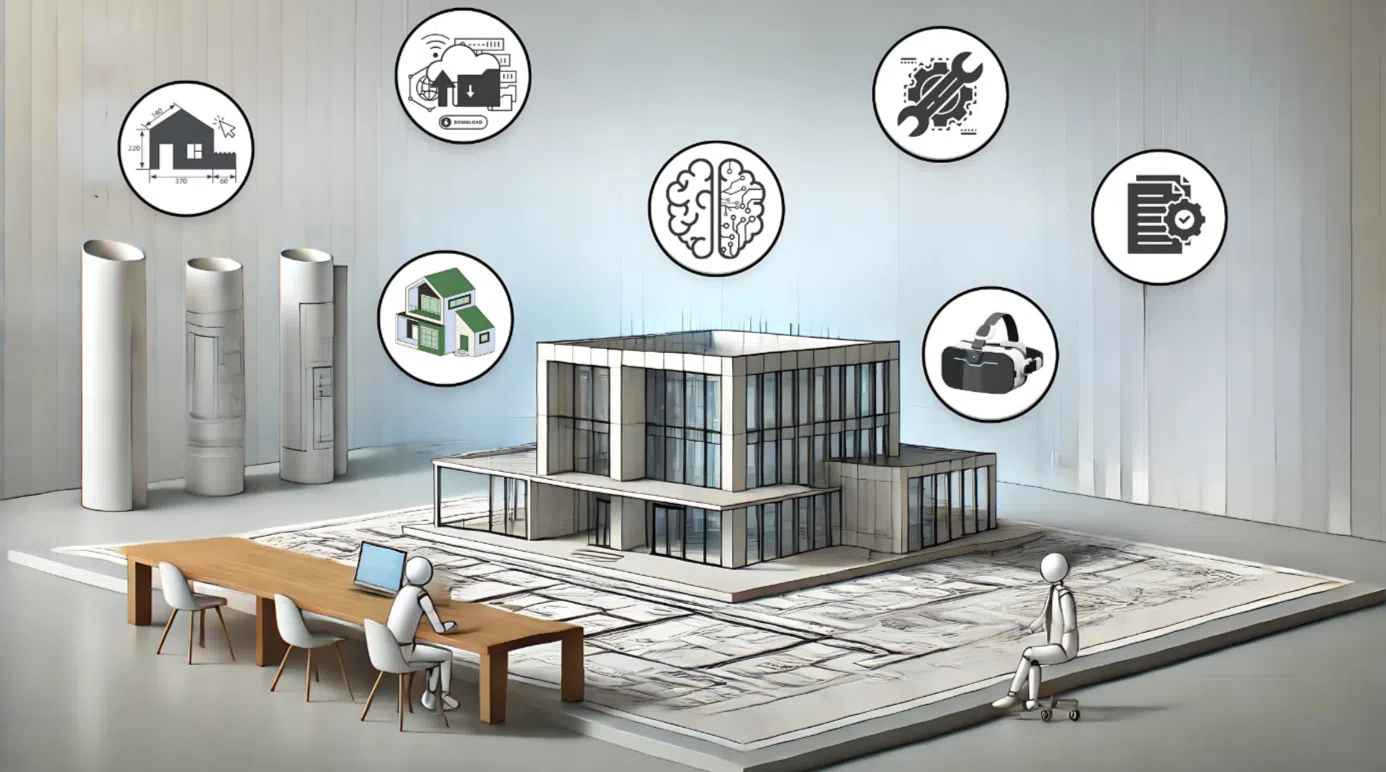
Building Information Modeling (BIM) has revolutionized the construction industry and now an indispensable part of modern buildings, enabling teams to collaborate more effectively and streamline the project delivery. Despite the benefits, BIM tasks involve numerous repetitive and time-consuming tasks that consume a lot of your productive time and divert attention to meet the deadline rather than focusing on quality and more sustainable alternatives. AI has potential to automate the routine BIM tasks, fostering efficiency and precision across the industry.
Role of AI in BIM Automation
Artificial intelligence offers unparallel opportunity to simplify and accelerate BIM tasks by leveraging machine learning, generative AI, natural language processing (NLP) and computer vision. It gives an opportunity to analyze vast amounts of data, identify patterns, and make data driven decisions that automate the task which previously took hours.
- Data Validation and Quality Assurance
AI – powered tools are making it easier to validate models under set compliance policies and ensure data accuracy. AI platforms like DeepBlocks assess and analyze designs in real time, flagging issues like clashes, noncompliance to regulatory and information gaps. It can combine financial data with 3D model to get the development analysis which can be customized on parameter of parking, setbacks, expenses and any other assumptions. The 3D model integrated with financial data gives return on cost (ROC) projection in real time using AI algorithms. It helps to calculate the minimum desired return on construction investment which can be exported in the required format like PDFs or CSV. - Clash Detection & Resolution
Currently, coordinating a BIM model takes a lot of time in manually checking the models and assigning each clash to relevant team or person, where it is resolved and updated in common data environment. AI powered plugins and tools can be developed to automate clash resolution in BIM. Federated BIM models incorporate a couple of separate models from various disciplines like architecture, structure, MEP, external services etc. BAMROC is another emerging AI based tool which fix the clashed and provide the Clash resolution Diagnosis Report (CRDR), a compliance report at unparallel speed. It transforms BIM design by automating MEP clash resolution by moving, bending and adjusting MEP fixtures. Such AI tools utilize machine learning, rule-based systems, optimization algorithms and natural language processing (NLP) techniques to automate required tasks. Such tools aim to streamline MEP coordination process, reduce manual intervention and enhance overall project timeline and efficiency. - Generative Design
AI can be a great assisting tool to produce generative design by creating multiple design iteration depending on predefined constraints. The constraints can be the site conditions, sustainability goals and cost on the project. Such AI tools allow professionals to explore optimal solutions, which would have taken ages to generate manually.
Spacemaker by Audodesk is an AI powered solution that provides assistance to architects and urban planners to design site proposals. It creates 3D mass models of the site and its surroundings using automatic data sets. It tests the site proposals and gives accurate analyses depending on more than 100 constraints like noise, sun, water management and more. It helps you to make better decisions, accelerate site planning and improve collaboration as it is a cloud-based AI solution. - Documentation and Reporting
Previously, there had been a separate designation of document controller for each discipline of the project who was responsible for saving every document and recording updates and revisions. This work has now been automated by using a common data environment but still involves manual work of drafting reports and other project documents. Documentation can be automated by utilizing artificial intelligence, tools like testfit can provide generative design and the relevant documents for proposal. AI is far more efficient in spotting errors and anomalies. - Automating sheet and view creation
AI and machine learning can be leveraged using rule-based programming and APIs to get more intelligent and adaptable to sheet and view creation. Tagging and dimensioning in 2D view consumes a lot of time for BIM professionals, using AI plug ins can speed up the view creation and designers can save time for more productive tasks. Rule based view setting can be applied to get the required views on the sheets. AI can learn from the previous data so it can make context aware decisions based on previous practices reducing the repeated actions. Similarly, algorithms can be developed to spot and fix errors of overlapping text or annotation categories. - Clash Tolerance/Soft Clashes
Depending on the project and equipment fitted in specific space, required clearances must be ensured to keep the equipment safe and provide enough space for maintenance. It is achievable using clash detection software like Navisworks by setting the tolerance parameter, but it involves a lot of manual work and requires you to visualize each collision separately. AI – powered tools can automate this manual process in which they can highlight the fixtures and equipment with not enough tolerance or move it as per the set instructions. Tolerance thresholds are preset for each type of equipment and can be changed as per the circumstances. - AI Based Renders and AR/VR
Showing visualization of BIM model is important for business growth and stakeholder satisfaction. AI based renderings are far more optimized with the hardware and faster as compared to manual rendering in Lumion and Twinmotion, it demands high spec hardware and time. AI has the potential to optimize BIM files into a format supported by Augmented reality headsets. This can be later used for marketing purposes and gives a coherent narrative to the project to give it more value. Similarly, walk through can also be developed to show a broader view of an area or complete project, it can either be used for design presentation, validating emergency routes and visualization to spot errors. Virtual reality integrated with artificial intelligence can be much faster than manual workflow and can add adjacent building blocks to get a clear view of project well before the start of onsite construction.
Automating BIM tasks is not just about saving time, it’s more about empowering the professional to focus on more innovative and productive tasks. Integrating AI with BIM can make BIM workflow smarter, faster and sustainable.